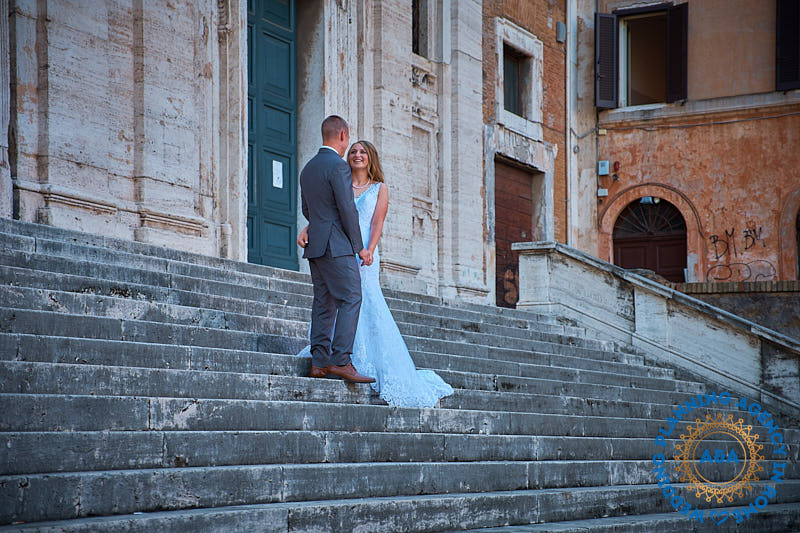
There are three ceremony types in Rome, and the right one depends on what you want from the day. If you are Roman Catholic, the choice is a Catholic ceremony in a church. If you are not Catholic but you want a legally binding marriage, the choice is a civil ceremony at a Hall of the Municipality. If you want a relaxed, personalised celebration anywhere you like in the historic city, with your own script and a ritual, and no paperwork at all, the choice is a symbolic ceremony — and it is the first choice for destination weddings. A symbolic ceremony has no legal value, so couples marry legally at home before or after and keep the real celebration here in Rome.
A quick note on prices: we work only in euros (€). We suggest converting to your own currency using your bank’s current exchange rate, as figures shift day to day.
Alessia&Alexander have planned and celebrated weddings in Rome since 2008, and this is the question couples ask us before any other. Roughly half of our couples choose a symbolic ceremony, a quarter a civil one and a quarter a Catholic one. Below is how each of the three actually works — where it can be held, what it needs from you, what it costs, and who it suits.

What is a civil ceremony in Rome, and where can it take place?
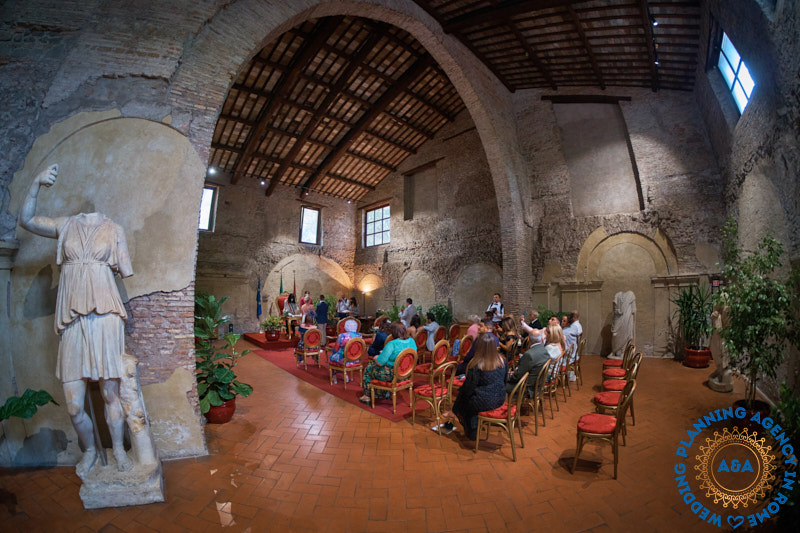
A civil ceremony is a legally binding marriage performed by an officer of the Municipality. In the centre of Rome it can take place in only two places: the Sala Rossa at the Campidoglio, and the Complesso Vignola Mattei at Caracalla, formerly the church of Santa Maria in Tempulo. There are also lovely small Town Halls close to Rome, such as Tivoli and Frascati, where we organise civil weddings as well.
The ceremony lasts around twenty minutes, and for the comfort of everyone present we suggest no more than thirty to forty guests. It is performed in Italian only, and Italian law requires that you understand what the celebrant says, so a translator is required. We include an Italian to English translator in our civil ceremony service as standard, and we can source other languages.
At the end of the ceremony you receive a multilingual civil marriage certificate that already includes English, with no further legalisation or apostille. You can ask for the Italian-only version instead, and if your own country requires an apostille on the certificate, we arrange that too.
There is very little to personalise. You can exchange your vows briefly and exchange rings, and your photographer is allowed throughout. Music and decorations are not usually permitted. Book the date as soon as you decide, because the Town Hall does not take bookings more than six months ahead of the wedding.
What it costs. Our work starts from € 1,800 and covers the organisation, the paperwork assistance and your photography during the ceremony and 30 minutes after. The Town Hall fee is separate and paid by you: € 1,392 on weekdays and € 1,624 on Saturdays and Sundays in Rome, for couples not resident in Rome, and € 150 to € 800 in the smaller towns nearby. The documents themselves usually fall between € 200 and € 700, depending on your nationality (Italian-side costs only; fees in your own country are separate).
The two things couples most often misunderstand: the paperwork is not quick, and it can take months; and a legal marriage cannot be held just anywhere in the city. The full procedure for each nationality is in our guide on whether foreigners can legally get married in Rome.
What is a Symbolic Ceremony, and why do most couples choose it?
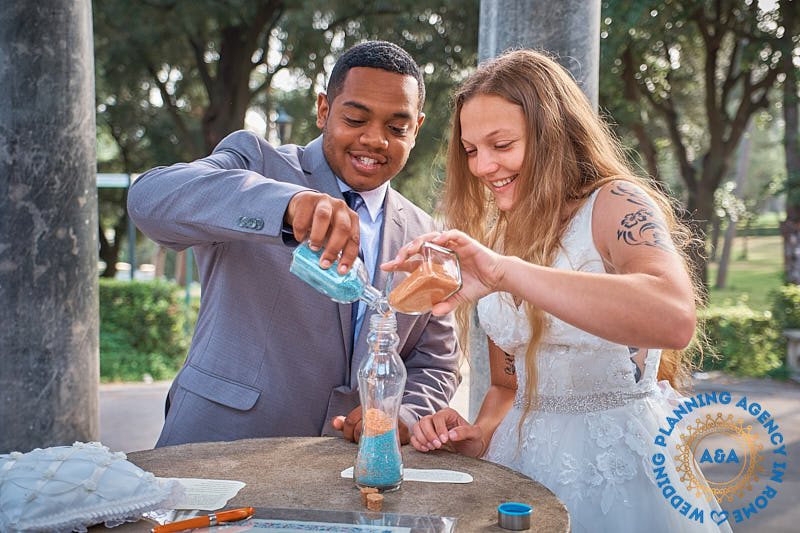
A symbolic ceremony has no legal value, and that is precisely what makes it simple. There is no paperwork, no Town Hall, and no restriction on where you stand when you make your promises. Alessia is a certified officiant and celebrates all our symbolic ceremonies herself, in English. Once we are hired we send you a questionnaire, and she writes a personalised script around your story, adding the elements that suit the two of you.
A symbolic ceremony can be held at a public spot, with no rental fee, or at a private location, which charges its own. It can be somewhere famous, with the Colosseum behind you, or quiet, like the gardens of Villa Borghese — and we keep a curated list of beautiful, calm spots where we celebrate often.
The rituals couples choose most are handfasting and the sand ceremony. We also perform candle, wine, ring warming and letter rituals.
At a public spot we always recommend early morning. The temperature is bearable — in summer Rome reaches 35 to 40 degrees by midday — the place is quiet rather than crowded, and the soft light is far better for photographs than the hard sun of the afternoon. Keep it to around ten guests at a public spot, because it becomes crowded quickly, and note that the Municipality of Rome does not allow any setup, decoration or chairs there. At a private location, any time of day and any number of guests work, as long as there is room. The ceremony itself lasts twenty to thirty minutes, depending on your vows and the readings you choose.
Couples usually marry legally at home, before or after their day in Rome. Most go to their local registry office simply to sign, and the real wedding is here.
What it costs. From € 750, which includes the organisation of the ceremony, your celebrant, your personalised script and your photography. Photography covers the ceremony and 30 minutes after. A private location adds its own rental fee, and a reception is extra.

How does a Catholic ceremony in Rome work?
There are more than nine hundred churches in Rome, so finding the right one is never the difficulty. Among the best known are the Basilica di Santa Maria in Trastevere, the Basilica di Santa Maria in Aracoeli, the Basilica dei Santi Giovanni e Paolo and the Chiesa di Sant’Ignazio di Loyola. We also know quieter, historic churches, baroque and hidden, where a small group feels as though the place belongs to them alone.
The paperwork begins with your own parish. Your parish priest prepares the document permitting you to marry abroad, and it is valid only if it carries both his signature and the stamp of the bishop. He will usually also ask for your baptism and confirmation certificates and ask you to complete a premarital course, and he may have requirements of his own. That document is sent to us in Rome, and we complete the process on your behalf. Allow at least a month; how long it takes depends on your parish.
Only one of you needs to be Catholic. The other can be of any religion. If either of you has been divorced, the previous marriage must first be declared null by a Church tribunal, whether that person is Catholic or not, and that is handled by your own diocese at home before anything else begins.
Rome has priests from all over the world, so the Mass can be celebrated in English, German, French, Spanish, Croatian or almost any language you need.
What it costs. Our work starts from € 1,800 and covers the organisation, the paperwork assistance and your photography during the ceremony and 30 minutes after. The church fee ranges from € 270 to € 1,500, and there is an offering of around € 100 for the priest who celebrates your Mass. Both are paid directly by you, in Rome.
Is a Catholic wedding in Rome legally valid?
It can be, and there are two ways to do it.
- A Catholic wedding that is legally binding. You prepare the religious file and the civil file, exactly as you would for a civil marriage. At the end of the Mass the priest reads the articles of the Italian civil code, you sign both the religious and the civil documents, and the marriage is registered as both a Catholic and a civil one. Two in one.
- A Catholic wedding with no civil effect. To skip the legal part here, you must already be legally married. You do that in your own country before the religious ceremony in Rome, and in addition to the religious documents you provide your civil marriage certificate as proof.
The order matters. It is not possible to celebrate the Catholic wedding first and the civil one at home afterwards. Some countries do it that way; in Italy the civil marriage comes first, then the Catholic one. And there is no sense in holding two weddings in Rome, a civil one at the Town Hall and then a Catholic one in church.

Which ceremony is right for you?
- A Catholic ceremony — for a religious couple who want to marry in church.
- A Civil ceremony — for a couple who want a legally binding marriage and want Rome to be the one and only wedding.
- A Symbolic ceremony — for a couple who want to celebrate and enjoy the day with the greatest possible freedom.
Most couples write to us already knowing roughly what they want. Others ask for a quote, or simply ask what the difference is. Either way we explain all three in full — the prices, where each one can be celebrated, when, and what paperwork it needs — and you decide from there. If the budget is what you are weighing up, our guide to what a wedding in Rome costs sets out the whole picture, and our elopement page covers celebrating with just the two of you or a handful of guests, whichever ceremony you choose.
Three real ceremonies in Rome
A civil ceremony. Agnes and Bob, from the United Kingdom, married on a warm October day at Vignola Mattei, in the Caracalla Hall. They wanted an intimate legal marriage with their closest family and friends, and a meaningful celebration inside a historic Town Hall. Everything ran smoothly: they exchanged their vows, and afterwards there were photographs and a reception on a panoramic rooftop.
A symbolic ceremony. Deziree and Anthony travelled from the United States to tie the knot in Rome. They eloped with a couple of friends as witnesses and had a romantic symbolic ceremony in the gardens of Villa Borghese. The day began with the preparations at the hotel and moved on to the spot where they married, and a photo session at the Colosseum, Campidoglio square and the Roman Forum completed the experience.
A Catholic ceremony. Miriam and Sean came all the way from Ireland to marry at the Basilica di Santa Maria degli Angeli e dei Martiri, in the centre of the city. The basilica welcomed their large group for a heartfelt Mass that included the lighting of the candles, accompanied by the sound of its monumental organ. Afterwards the newlyweds continued to the panoramic points of Villa Borghese and the Spanish Steps, then rejoined their guests for a party at the hotel.

Ready to choose your ceremony in Rome?
Tell us your date, roughly what you picture and whether the marriage needs to be legally binding, and we will tell you which of the three fits, what it involves and what it costs. No obligation.
Frequently asked questions
What is the difference between a civil, a Catholic and a symbolic ceremony in Rome?
A civil ceremony is a legally binding marriage celebrated by an officer of the Municipality, in one of its Halls. A Catholic ceremony is celebrated in a church and can be made legally binding if the civil file is prepared alongside the religious one. A symbolic ceremony has no legal value, needs no paperwork, and can be held anywhere in the city.
When do we have to prepare paperwork?
For a legal civil marriage and for a church wedding. Most documents are valid for six months. A symbolic ceremony needs no paperwork at all.
Can we have a legal marriage outdoors in Rome, with a view of the Colosseum?
No. To be valid, a civil marriage in Rome takes place only at the spots established by the Municipality, the Sala Rossa and Vignola Mattei. A ceremony outdoors or anywhere else in the city is symbolic and has no legal value.
Can a priest celebrate our wedding outside a church, as a blessing?
No. A Catholic ceremony takes place in the church itself.
Can we have a symbolic ceremony in a church?
No, it is not permitted. Only Catholic weddings are celebrated in churches.
Can we take photographs in a church where we did not marry?
Yes. Any church can be visited for photographs, as long as no celebration or Mass is taking place.
You will find more answers on our FAQ page.
About the authors

We are Alessia&Alexander, Wedding, Elopement and Proposal Planners based in Rome since 2008, eighteen years of helping couples from all over the world marry in the Eternal City. We have had the joy of planning for more than 500 couples, and we believe in clear, honest budgets and a calm, personal journey from the first message to the last photograph. Alessia prepares the paperwork herself and Alexander photographs the day – it is only the two of us, from your first email to your Marriage Certificate. If Rome is calling you, we would love to hear your story. Start at our wedding planning page or our home page.